
Dr. Ahmad Shahzad
Founder | Lyallpur Diabetes Foundation
Consultant Diabetologist | Educator | Advocate for Preventive Care
Since we have defined already what each of these types of diabetes is and have also discussed the pathology of each in previous posts, it is high time to compare them directly. This gives a reader better insight into the ways these different conditions compare in a way that is significant to everyday life and lifelong health.
Side-by-Side Comparison of Type 1 vs Type 2 Diabetes
Enhance clarity and dispel confusion
Most individuals have a misconception of considering diabetes a single and homogenous disease. But Type 1 is autoimmune and needs life-long insulin, and Type 2 is insulin resistant and has lifestyle risk factors. These misconceptions are clarified by a comparative framework.
Supports better patient engagement and decision-making
Having the two sides comparing, even side by side, allows the readers to locate related symptoms, routes to diagnosis, and actions, faster–empowering their forces of action. As an example of this, Type 1 symptoms are abrupt and dramatic, whereas Type 2 comes across slowly and may last years without detection.
Bridges into more effective management strategies
The nature of the cause of each type, autoimmune destruction and insulin resistance, informs specific treatment: short-term insulin therapy or diet and lifestyle changes including potential remission interventions.
Raise awareness for public health and prevention
Being able to identify differences can be used to fight stigma as well as distinguish between personal accountability (Type 2 lifestyle risk) and autoimmune inevitability (Type 1). Further, it highlights that preventative measures, like lifestyle change, are applicable on Type 2 and not Type 1 at present.
Unites shared goals around complication prevention
They have different origins but both types can cause elevated blood sugar with severe consequences: heart disease, kidney failure, nerve damage, sight loss. This overlap brings emphasis on the need for caution and favors the need to maintain constant self-management, however of any kind.
Key Causes and Mechanisms
1. Autoimmune Nature of Type 1 vs. Insulin Resistance in Type 2
- Type 1 Diabetes is essentially an auto immune disorder. The 100% deficiency of insulin is due to the body immune system destroying the 166 insulin producing cells also known as the 166 100 in the 100 pancreatic.
- On the contrary, Type 2 Diabetes is not autoimmune. It is mostly associated with insulin resistance, i.e. the cells of the body respond less to insulin and in most cases the production of insulin may decline progressively.
Despite emerging evidence of chronic low-grade inflammation and partial immune-system involvement in Type 2, this does not represent the self-directed destruction of an autoimmune disease such as Type 1.
2. Differences in Pancreatic Function & Insulin Production
- With Type 1, the immune-mediated assault leads to the almost or total loss of the β-cells, stopping all the production of insulin.
- Type 2: starts with insulin resistance: at the start of the ailment, insulin manufacturing by β-cells elevates to oversupply. With time however, stress results in β-cell dysfunction and impaired insulin secretion.
3. Genetics, Lifestyle, and Environmental Triggers
Type 1 Diabetes:
- Risk is highly dependent on genetic predisposition. Certain HLA genes variations–HLA-DR3 and HLA-DR4– explain much of the heritability, and a high risk is present in family members.
- Genetically susceptible individuals are probably triggered by environmental factors. These can be viral infections, changes in diet, changes in microbiome of the gut–each of which could trigger or increase the autoimmune response.
Type 2 Diabetes:
- Insulin resistance is a huge factor due to lifestyle causes such as obesity, a sedentary lifestyle, unhealthy eating habits, and advanced age.
- Some are genetic as well: studies have associated loci around genes, including NAT2, GCKR, and IGF1 with an increased risk of insulin resistance.
- New data indicates that Type 2 Diabetes may have an epigenetic factor. As an example, DNA methylation and histone changes can silence or activate the 65 cells such as Pdx1, affecting long-term insulin synthesis.
Summary Table: Mechanistic Contrasts
| Mechanism | Type 1 Diabetes | Type 2 Diabetes |
| Immune involvement | Autoimmune β-cell destruction | No autoimmunity; chronic, low-grade inflammation |
| Insulin production | Virtually non due to cell loss | Initially increased, later diminished |
| Key drivers | Genetic susceptibility + environmental triggers | Lifestyle, genetic predisposition, epigenetic changes |
| Pancreatic role | Immune destruction of β-cells | β-cell compensation followed by eventual failure |
Onset and Progression
1. Typical Age of Onset & Symptom Speed
Type 1 Diabetes
- Usually during early childhood 4-6 years, early puberty 10-14 years.
- The highest incidence is between the age of 5-9 and again puberty.
- Although it more often attacks the young, adults can also get adult-onset Type 1 (LADA); the median age of onset approximates to 24 years.
- The development of symptoms occurs from day to weeks and is rapid in declining insulin output.
Type 2 Diabetes
- Historically, it is observed in the mature years, particularly after the age of 40, but it is increasingly being diagnosed in the young adults and adolescents.
- In adolescents, it is usually diagnosed in the post-pubertal period, especially when one is 15–19-year-old.
- The beginning of symptoms starts slowly and may remain invisible in years. Large numbers are diagnosed in screening.
- Youth-onset Type 2 almost always develops quite rapidly and can often cause complications earlier and more severe than adult-onset type 2 or youth onset type 1.
2. Progression Speed & Evolution Over Time
| Type | Speed & Course |
| Type 1 | Rapid onset and progression; especially in younger children, disease evolves quickly. Adult-onset (LADA) is slower but still insulin-dependent. |
| Type 2 (Adults) | Slow, insidious onset; insulin resistance builds gradually with eventual beta-cell decline. |
| Type 2 (Youth-Onset) | More aggressive disease course; leads to earlier vascular and metabolic complications. |
3. Patterns Among Children, Teens & Adults
Children & Teens
- Type 1: Onset is mostly between 4-14 years and symptoms are rapid.
- Type 2: Prevalence that is increasing with obesity. Generally diagnosed after puberty (15-19), and less symptomatic-or even asymptomatic-at diagnosis.
Young Adults
- LADA (Latent Autoimmune Diabetes in Adults): Another type 1 occurs later in life and can be mistaken as Type 2 because it has less intensity and speed.
Adults (40+)
- Characteristic Type 2 presentation, gradual onset usually linked to lifestyle and age-related insulin resistance.
4. Symptom Patterns
Sudden vs. Gradual Onset
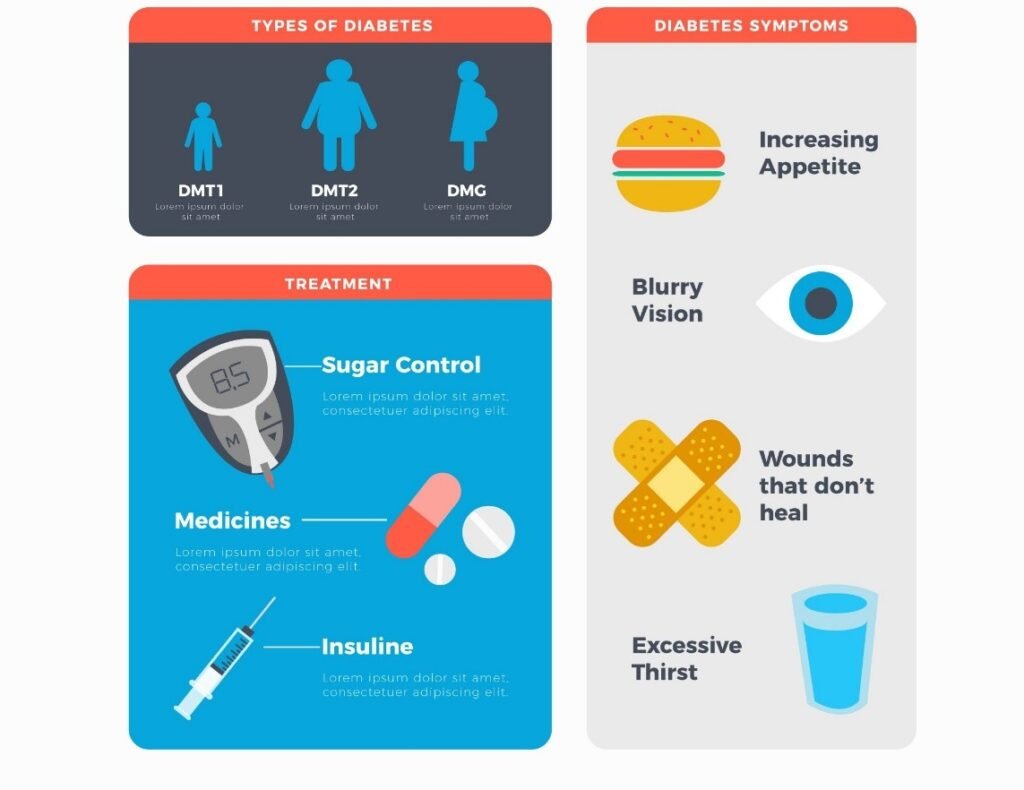
· Type 1 Diabetes: Symptoms progress usually abruptly i.e. within days to weeks and can be quite severe (e.g., excessive thirst, frequent urination, unexplained weight loss, makes it severe in children and adolescents).
· Type 2 Diabetes: The symptoms become more progressively evident in years and can go unnoticed until the time the level of blood sugar is too high to get treated.
Unique or More Prominent Symptoms
- Type 1: Commonly accompanied by standard emergency indications of diabetic ketoacidosis (DKA) e.g., fruity breath, nausea, abdominal pain, rapid breathing) that indicate a high degree of care is required.
- Type 2: may show subtle skin neutrophilization such as acanthosis nigricans (darkened areas/patches) and chronic wounds in more cases than Type 1.
Overlapping Warning Signs & Urgent Red Flags
Both types share core symptoms—thirst, frequent urination, fatigue, blurred vision. Prompt medical attention is critical when signs of DKA appear (e.g., dehydration, fruity-smelling breath, difficulty breathing) or if symptoms escalate quickly, especially in Type 1 cases.
5. Diagnosis and Testing
Blood Glucose and HbA1c Benchmarks
- Diagnosis is based on fasting or random blood level of glucose and HbA1c. ≥6.5% HbA1c to test diabetes; 5.7-6.4% is prediabetes.
- HbA1c test indicates average glucose in 2-3 months and is an important instrument in not only diagnosis but constant monitoring.
Tests That Differentiate Type 1 vs. Type 2
- Autoimmune destroying markers are identified automatically- highly indicative of Type 1.
- C-peptide – quantifies endogenous insulin production: the lowest quantities are indicative of Type 1, whereas higher results are more characteristic of Type 2 or other types such as LADA.
Why Early and Accurate Diagnosis Matters
Early, correct diagnosis of the type of diabetes allows adequate treatment, e.g. quick insulin titre in the case of Type 1 and helps avoid potentially fatal conditions such as DKA or chronic organ failure
6. Treatment Approaches
Type 1: Lifelong Insulin
· Type 1 only necessitates lifelong insulin treatment, usually in the form of numerous daily shots, or pump regimens customized through blood glucose monitoring, and support of a medical team.
Others may eventually present a honeymoon period during which they need less insulin before full dependence on insulin returns.
Type 2: Lifestyle and Medications
- Initial management consists of lifestyle modification: a healthy diet, weight loss, and regular physical activity. These work quite well on their own with many patients.
- Oral or injectable medication (e.g., metformin, GLP-1 agonists) can then be added as the disease worsens; insulin is only approved in case of ongoing glucose control.
Management vs. Remission
- Type 1: The management is lifetime; the disease is irreversible.
- Type 2: Non-curative, but remission possible, particularly with early aggressive lifestyle intervention (e.g, plant-based diets) to sustainable HbA1c levels below 6.5 per cent without medication.
You may also like to read: Type 2 Diabetes
8. Long-Term Complications
Shared Risks When Uncontrolled
Both poorly controlled, may result in severe microvascular complications (retinopathy, nephropathy, neuropathy) and macrovascular harm (heart disease, stroke).
- Retinopathy: Both types result in around 80 percent incidences of vision disturbances in chronic cases; the risk increases with progressive illness and poor treatment.
- Neuropathy: The second problem that is common after many years of unmanaged blood sugar, which causes numbness, pain, or autonomic problems.
How Risk Timelines Differ
- Type 1: Can experience complications earlier, when unstable levels of glucose and when appearing at a younger age.
- Type 2: In many cases, the complications subtly accumulate during a period of 5 to 10 years or even longer before the patient is diagnosed, since symptoms do not progress rapidly.
Importance of Continuous Monitoring and Care
Continuous care- glucose monitoring, periodic exams (eye, kidney, nerve) health style, and physician attention are necessary to reduce risks and maintain a good quality of life.
Final Note
These paragraphs give a strong evidence-based background to your diabetes research paper that is optimized to SEO. Go ahead and ask for additions such as a chart, patient cases, or external calls like “Type 1 red flags to be aware of” or “Ways to lower Type 2 risk starting today.”